Choosing the right commercial water purifier is not just a purchasing decision, it is an operational decision that affects water availability, quality consistency, and long-term costs. Many businesses select a system based on guesswork or future assumptions, only to face shortages during peak hours or unnecessary energy and maintenance expenses.
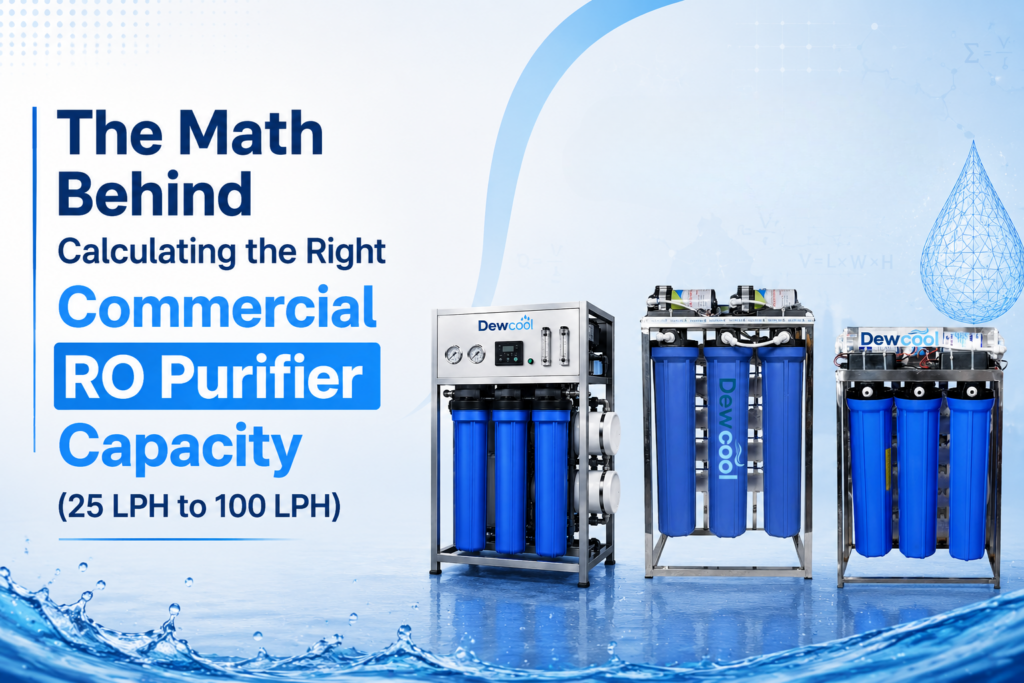
The good news is that selecting the correct commercial RO water purifier capacity between 25 LPH and 100 LPH is not complicated. It is a numbers-driven decision grounded in daily consumption patterns, peak demand, and system efficiency. Once you understand the math behind it, the process becomes logical, repeatable, and reliable.
This blog breaks down the calculations in clear, practical terms so you can confidently determine the right capacity for your business.
Why RO Purifier Capacity Matters in Commercial Settings
Capacity refers to how much purified water a system can produce per hour, measured in liters per hour (LPH). In commercial environments, underestimating this number leads to water shortages, while overestimating increases capital and operating costs.
A correctly sized commercial water purification system ensures the following:
- Continuous supply during peak usage
- Stable water quality across operating hours
- Lower stress on RO membranes and pumps
- Reduced electricity and maintenance expenses
Capacity planning is not about maximum usage; it is about consistent availability when demand is highest.
Step One: Calculating Daily Water Requirement
The foundation of capacity planning starts with daily consumption. This depends on the type of establishment and how water is used.
Typical Commercial Water Usage Benchmarks
- Offices: 3–5 liters per person per day
- Restaurants: 2–5 liters per customer
- Clinics: 3–6 liters per patient
- Schools: 2–3 liters per student
Example:
A small office with 30 employees using 4 liters per person per day:
30 × 4 = 120 liters per day
This number alone does not determine capacity, but it sets the baseline.
Step Two: Understanding Peak Demand Hours
Commercial water usage is rarely evenly distributed. Most consumption happens in short bursts: morning hours, lunch breaks, or service rushes.
Why Peak Demand Is the Real Metric
RO systems produce water gradually. If most consumption happens within a few hours, your purifier must keep up during that window.
Example:
If the office consumes 120 liters mostly between 9 AM and 1 PM (4 hours):
120 ÷ 4 = 30 LPH required
This immediately rules out smaller systems and positions a 25–50 LPH purifier as a more realistic option.
Step Three: Factoring in Storage Tank Capacity
Most commercial RO systems include a storage tank. This allows you to combine production rate with stored water to handle short-term surges.
Production vs. Availability
- RO output = continuous water generation
- Storage = buffer for peak usage
Practical insight:
A 25 LPH purifier with a 100-liter storage tank can often perform like a higher-capacity system for small operations, provided refill cycles are managed correctly.
However, relying too heavily on storage without sufficient LPH leads to refill delays and inconsistent pressure.
Step Four: Matching Business Type to RO Capacity
Below is a simplified capacity guide based on real-world usage patterns.
25 LPH Commercial RO Purifier
Best suited for:
- Small offices (up to 20–25 people)
- Boutique clinics
- Small retail outlets
Daily output potential:
25 × 10 operational hours = 250 liters/day
50 LPH Commercial RO Purifier
Ideal for:
- Medium offices
- Small restaurants or cafés
- Coaching centers
Daily output potential:
50 × 10 = 500 liters/day
100 LPH Commercial RO Purifier
Recommended for:
- Large offices
- Commercial kitchens
- Schools, hostels, or gyms
Daily output potential:
100 × 10 = 1,000 liters/day
Actionable takeaway:
Always select capacity based on peak hourly demand, not total daily consumption alone.
Step Five: Accounting for RO Recovery Rate
RO systems do not convert 100% of input water into purified water. The recovery rate typically ranges from 40% to 60%.
Why Recovery Rate Matters
If your system produces 50 liters of purified water, it may require 80–120 liters of input water.
This impacts:
- Borewell or municipal water availability
- Pump sizing
- Operating cost
For commercial planning, always confirm that your raw water supply can support both the output and rejection volumes.
Common Capacity Planning Mistakes to Avoid
- Planning only for today: Businesses grow. Add a 20–30% buffer for future expansion.
- Ignoring peak usage: Average consumption figures can be misleading.
- Undersizing to save cost: Smaller systems run longer, wear faster, and fail sooner.
- Overlooking water quality: High TDS water reduces membrane efficiency, lowering actual output.
Practical Capacity Selection Formula
Here is a simple working formula:
Required LPH = (Peak-hour water usage ÷ peak usage hours) × safety margin
Example:
Peak usage = 200 liters
Peak hours = 4
Safety margin = 1.25
(200 ÷ 4) × 1.25 = 62.5 LPH
In this case, a 100 LPH commercial RO water purifier is the safer long-term choice.
How the Right Capacity Saves Money Long-Term
Selecting the correct commercial water purifier capacity is not an expense; it is a cost-control strategy.
Proper sizing results in:
- Lower membrane replacement frequency
- Reduced electricity consumption
- Consistent water pressure and taste
- Fewer operational interruptions
Over five years, the difference between an undersized and correctly sized system can amount to significant savings.
Calculating the right commercial RO purifier capacity between 25 LPH and 100 LPH is a matter of understanding demand, timing, and system behavior. By analyzing daily consumption, identifying peak usage hours, and factoring in storage and recovery rates, businesses can make data-driven decisions rather than assumptions.