Access to reliable drinking water is a basic requirement for every modern facility. Offices, schools, hospitals, factories, hotels and public spaces all need a dependable way to provide clean and suitably cooled drinking water throughout the day.
However, as facilities become larger and more technology-driven, traditional water coolers may not provide the level of monitoring, efficiency and maintenance control that facility managers need.
This is where smart water cooler solutions are becoming increasingly relevant. By combining water dispensing with connected monitoring, intelligent controls and automated alerts, modern systems can help facilities manage drinking-water infrastructure more efficiently.
But what makes a water cooler “smart,” and why should businesses consider upgrading?
What Is a Smart Water Cooler?
A smart water cooler is a connected drinking-water system that uses sensors and digital technology to monitor operational conditions and provide useful information to facility managers.
Depending on the system, monitoring may include parameters such as:
- Water temperature
- Water level
- Flow rate
- Pressure
- TDS levels
- Energy consumption
- System faults
- Filter or maintenance requirements
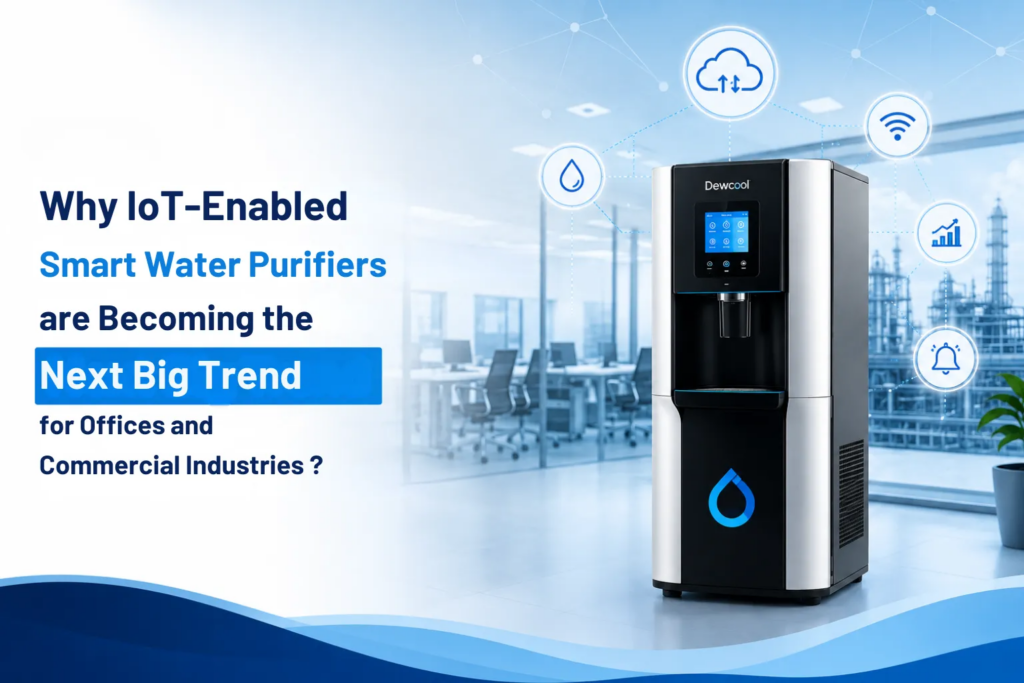
Some systems can connect this information to a cloud-based dashboard or mobile application, allowing authorised users to monitor equipment remotely.
Instead of simply dispensing chilled water, the system becomes part of a facility’s wider infrastructure management.
1. Real-Time Monitoring Improves Visibility
One of the biggest challenges with conventional water equipment is that problems may only become obvious when someone notices them.
For example, a facility manager may not know that water levels are low, cooling performance has changed or a component requires attention until users report an issue.
A smart system can provide real-time information about important operating parameters.
This gives facility teams greater visibility into how equipment is performing and can make it easier to identify unusual readings before they become larger operational problems.
For facilities with multiple water points, centralised monitoring can be particularly useful because managers can review equipment information without physically checking every unit.
2. Predictive Maintenance Can Reduce Unexpected Downtime
Maintenance is an important part of managing commercial water equipment.
Waiting until a system stops working can cause inconvenience for employees, students, patients, visitors or customers. It may also result in emergency service requirements.
Smart systems can use monitoring data and alerts to identify conditions that may require attention. Notifications can be used for issues such as filter replacement, abnormal readings, low water levels or system faults.
This supports a more proactive maintenance approach.
Rather than relying entirely on manual inspections or waiting for equipment failure, facility teams can use available data to schedule maintenance when it is needed.
3. Smart Water Purifier Technology Adds Another Layer of Monitoring
Cooling is only one part of a facility’s drinking-water requirements. Where the incoming water requires treatment, purification also needs to be considered.
A smart water purifier can combine purification technology with sensors, automation and digital monitoring.
Modern smart purification systems may monitor parameters such as TDS, flow, pressure, temperature and equipment performance. Connected dashboards can also provide historical information that helps operators understand how the system is performing over time.
For commercial buildings, hospitals, hotels and industrial facilities, this type of visibility can be useful when managing water treatment equipment as part of a larger facility operation.
It is important to remember that cooling and purification serve different functions. A water cooler primarily cools and dispenses water, while a purification system is designed to treat water according to the requirements of the incoming water source and selected treatment technology.
4. Energy Efficiency Matters in Large Facilities
Water coolers may operate for long periods, particularly in facilities with high daily usage.
As a result, energy consumption becomes an important consideration when selecting equipment.
Smart systems can incorporate intelligent cooling controls that adjust operation according to demand rather than relying solely on continuous operation.
Energy monitoring can also give facility managers greater visibility into consumption patterns.
This information can help organisations understand how equipment is being used and identify opportunities to improve operational efficiency.
For large facilities operating multiple units, even small improvements in energy management can become more significant when considered across the entire site.
5. A Cold Water Cooler Still Has an Important Role
Despite the growth of connected technology, not every facility needs a fully smart system.
A Cold water cooler can remain a practical solution for environments where the main requirement is a reliable supply of chilled drinking water.
Traditional cold-water systems are available in different cooling and storage capacities, making them suitable for environments ranging from smaller offices and schools to facilities with higher water demand.
When selecting a cold water cooler, facility managers should consider factors such as:
- Number of users
- Peak-hour demand
- Cooling capacity
- Storage capacity
- Available installation space
- Construction materials
- Hygiene requirements
- Maintenance needs
- Energy consumption
The goal is not necessarily to choose the most technologically advanced system. It is to choose a solution that matches the facility’s actual requirements.
6. Smart Solutions Can Support Multiple Locations
Large organisations may operate several buildings, departments or facilities.
Managing water equipment across multiple locations can become difficult when every unit needs to be inspected individually.
Connected systems can provide centralised access to operational information, allowing facility teams to monitor multiple units from a common interface where the system supports it.
This can be particularly useful for organisations managing:
- Corporate offices
- Schools and educational campuses
- Hospitals
- Hotels
- Factories
- Warehouses
- Public infrastructure
- Residential complexes
Remote monitoring does not eliminate the need for physical maintenance, but it can help teams identify which equipment requires attention and prioritise service activities.
7. Hygiene and Water Safety Should Remain a Priority
Technology should not replace fundamental hygiene and maintenance practices.
Water-contact components, storage tanks, filters and dispensing points need appropriate cleaning, inspection and servicing according to the equipment manufacturer’s recommendations.
Facilities should also consider the quality of their incoming water when selecting purification technology.
A smart water cooler can provide useful operational data, but connected features do not automatically make water safe to drink. Water treatment requirements depend on the source, contaminants present and treatment system being used.
For this reason, smart monitoring should be viewed as an additional management tool rather than a substitute for proper water treatment and maintenance.
8. Choosing the Right Solution for Your Facility
Before investing in a smart water cooler or purification system, facility managers should assess their actual requirements.
Start by asking: How many people will use the system?
A small office and a large manufacturing facility will have very different water consumption patterns.
What is the incoming water source?
Municipal, borewell, tanker and other water sources may have different treatment requirements.
Is cooling the main requirement?
If the facility already has suitable purified water, a dedicated cold water cooler may be sufficient.
Is purification also required?
If incoming water requires treatment, a purification system or integrated solution may be more appropriate.
How important is remote monitoring?
For a single small installation, manual monitoring may be adequate. For multiple high-demand facilities, connected monitoring may provide greater operational visibility.
What maintenance support is available?
Consider installation, servicing, replacement components and technical support before making a long-term investment.
The Future of Facility Water Management
Modern facilities are increasingly using connected technology to manage infrastructure more efficiently. Drinking-water systems are becoming part of this shift.
A smart water cooler can provide more than chilled water. With connected sensors, monitoring dashboards, alerts and intelligent controls, it can provide facility teams with information that supports maintenance and operational decisions.
At the same time, conventional cold-water coolers continue to offer a straightforward solution where advanced monitoring is not necessary.
For facilities that also require water treatment, a smart water purifier can extend this approach by combining purification with real-time monitoring and automated notifications.
Ultimately, the right solution depends on the facility’s size, water source, user demand, operational priorities and maintenance capabilities.
Final Thoughts
Smart water cooler solutions are changing how modern facilities approach drinking-water management. Instead of treating a water dispenser as a standalone utility, organisations can increasingly integrate cooling, purification, monitoring and maintenance into a more connected system.
For high-demand environments, features such as real-time monitoring, remote access, maintenance alerts and energy management can provide useful operational visibility.
However, smart technology is not automatically the right choice for every facility. A reliable Cold water cooler may be all that is needed for a smaller or less complex environment, while larger facilities may benefit from connected cooling and purification solutions.
The best approach is to assess water quality, consumption, cooling requirements, maintenance needs and facility size before selecting the appropriate system.