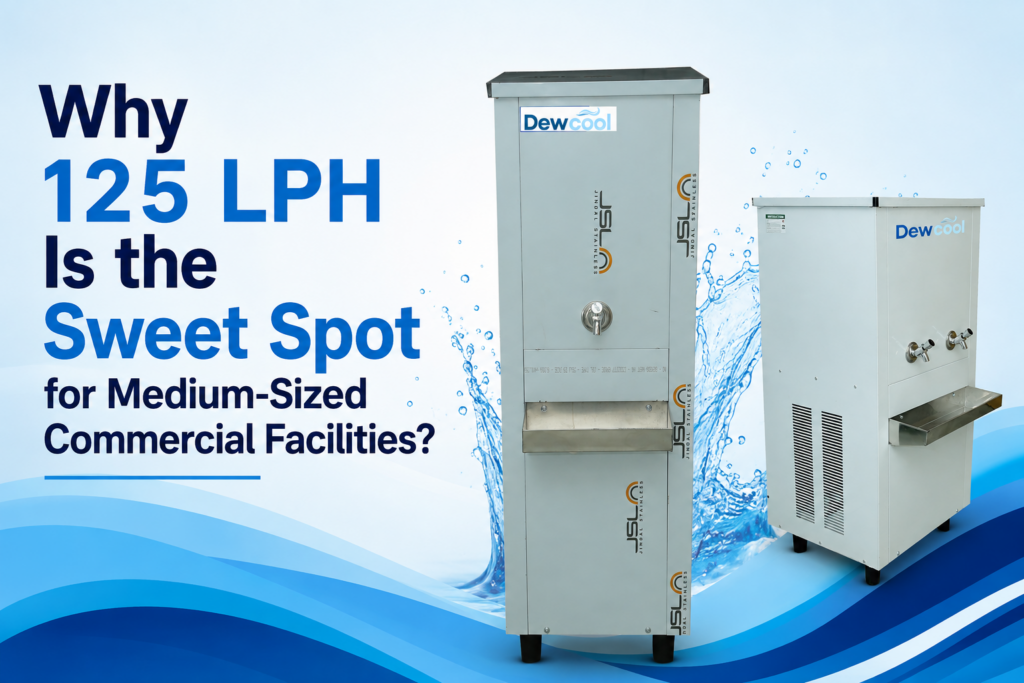
For a medium-sized commercial facility, choosing the right water purification capacity is rarely about buying the biggest system available. The real objective is to find a solution that can consistently meet daily demand without creating unnecessary equipment, maintenance, or operating costs.
This is where a 125 LPH water purification system can make practical sense.
An output capacity of 125 litres per hour sits at the starting point of industrial-scale purification systems, while smaller commercial purification systems commonly cover capacities below this level. For facilities that have moved beyond small-office requirements but do not need a very high-capacity plant, 125 LPH can provide a useful middle ground.
It is important to clarify one point: 125 LPH refers to the purification capacity of the system, not the cooling capacity or storage capacity of a high capacity water cooler. If a facility needs both purified and chilled drinking water, the purification and cooling requirements should be evaluated together.
What Does 125 LPH Actually Mean?
LPH stands for litres per hour.
A 125 LPH RO system is designed to produce up to approximately 125 litres of treated water per hour under its specified operating conditions. The actual output can vary depending on factors such as incoming water quality, pressure, temperature, membrane condition, recovery settings, and system configuration.
In simple terms:
- 125 litres/hour
- Approximately 2.08 litres/minute
- Around 750 litres over 6 hours at the rated output
- Around 1,000 litres over 8 hours at the rated output
These figures are theoretical operating calculations, not a guarantee of daily production. Real-world output should always be assessed against the manufacturer’s specifications and the facility’s water conditions.
This distinction is particularly important when comparing a Commercial Water Purifier with an industrial RO system. Commercial systems on the market may be designed for lower capacities, while industrial systems can begin at 125 LPH and scale considerably higher.
Why Medium-Sized Facilities Need More Than a Basic Purifier
A small office with limited staff may be adequately served by a lower-capacity purification system. However, the calculation changes when a facility has multiple departments, longer operating hours, visitors, employees across shifts, or several drinking-water points.
Common examples include:
- Medium-sized offices
- Schools and educational institutions
- Clinics and hospitals
- Hotels and hospitality facilities
- Factories and manufacturing units
- Commercial buildings
- Institutional campuses
The challenge is not simply the total amount of water consumed during a day. Peak demand matters too.
For example, employees may use significantly more drinking water during lunch breaks or shift changes. A school may experience concentrated demand during recess. A factory operating multiple shifts may require treated water throughout the day.
A system that looks sufficient based only on average consumption may struggle when demand suddenly increases.
Why 125 LPH Can Be a Practical Middle Ground
The appeal of 125 LPH comes from its position between smaller commercial systems and substantially larger industrial systems.
A facility that chooses a system that is too small may face:
- Longer purification cycles
- Insufficient treated-water availability during peak periods
- Greater dependence on storage tanks
- Pressure to operate the system continuously
On the other hand, selecting a significantly larger system than necessary can mean paying for additional capacity that the facility may rarely use.
A 125 LPH system can therefore be considered a practical starting capacity for certain medium-demand facilities, particularly when the expected consumption and operating schedule align with its production rate.
However, it should not be treated as a universal capacity recommendation. Water demand, source-water quality, number of users, operating hours, storage requirements, and future expansion should all be considered before selecting the system.
125 LPH vs. a High Capacity Water Cooler
One common source of confusion is treating purification capacity and cooling capacity as the same thing.
They are not.
A high capacity water cooler primarily addresses the need for chilled drinking water. Its important specifications can include cooling capacity, storage capacity, tank configuration, dispensing points, construction material, and energy consumption.
An RO purification system, by contrast, focuses on treating incoming water.
This means a commercial facility may need two complementary functions:
Purification → Storage → Cooling → Dispensing
For example, purified water can be transferred to a suitable storage or cooling system before being supplied to users.
The right configuration depends on the facility’s requirements. A water cooler alone does not necessarily purify water, while an RO system does not automatically provide chilled drinking water. Separating these requirements during the planning stage can prevent capacity mismatches.
Water Quality Should Influence the System Design
Capacity is only one part of the decision.
The quality of the incoming water should also be assessed before selecting an RO system. Water may come from municipal supplies, borewells, tankers, or other sources, and its characteristics can differ considerably.
An RO system generally works as part of a broader treatment process. Depending on the application, pretreatment can include sediment filtration, activated carbon filtration, chemical dosing, or other treatment stages.
The industrial RO configuration described on the website uses stages including pre-filtration, reverse osmosis, and post-treatment, with optional UV disinfection.
This approach aligns with a broader water-safety principle: drinking-water quality should be managed across the complete supply chain rather than relying on a single treatment step. The World Health Organization recommends risk-based water safety planning covering the supply system from source through to the consumer.
What Makes an RO System Suitable for Commercial Use?
When evaluating a 125 LPH system, facility managers should look beyond the litres-per-hour figure.
Important considerations include:
1. Pretreatment
Sediment and carbon filtration can help protect downstream RO components by addressing suspended particles and certain contaminants before water reaches the membrane.
2. RO Membrane Configuration
The membrane is the core treatment component responsible for separating many dissolved substances from the feed water. Reverse osmosis uses pressure to force water through a semipermeable membrane, producing treated water and a concentrated reject stream.
3. Storage
Purification capacity and storage capacity should be planned together. Adequate storage can help accommodate periods when demand is higher than the instantaneous purification rate.
4. Monitoring
Flow meters, pressure gauges and control systems can help operators monitor system performance and identify potential maintenance requirements. Industrial systems may also incorporate more advanced monitoring and automation.
5. Maintenance
RO membranes, filters, media and other components require maintenance according to operating conditions and manufacturer recommendations. A maintenance plan helps preserve water quality and system performance.
6. Future Demand
A facility that expects expansion should consider whether its current purification capacity will remain appropriate as employee numbers, production levels, or operating hours increase.
125 LPH: A Practical Starting Point, Not a Universal Rule So, is 125 LPH the sweet spot?
For some medium-sized commercial facilities, yes, it can be a practical starting point because it bridges the gap between lower-capacity commercial purification and larger industrial systems.
But the number should never be selected in isolation.
A well-designed drinking-water solution considers:
- Daily water consumption
- Peak-hour demand
- Raw-water quality
- RO recovery and operating conditions
- Storage requirements
- Cooling requirements
- Available installation space
- Electricity and operating costs
- Maintenance requirements
- Future expansion
The best system is ultimately the one whose capacity, treatment process, storage and cooling arrangement work together as a complete solution.
For facilities evaluating a Commercial Water Purifier, moving toward a 125 LPH system can be worth considering when demand has outgrown smaller systems but does not yet justify substantially higher capacity. And where chilled drinking water is also required, pairing purification with an appropriately sized high capacity water cooler can create a more complete drinking-water setup.
Before making a final selection, obtain a water-quality report, estimate peak demand, and compare the system’s rated performance with the facility’s actual operating requirements. That approach provides a more reliable basis for choosing water treatment capacity than simply selecting the largest available model.