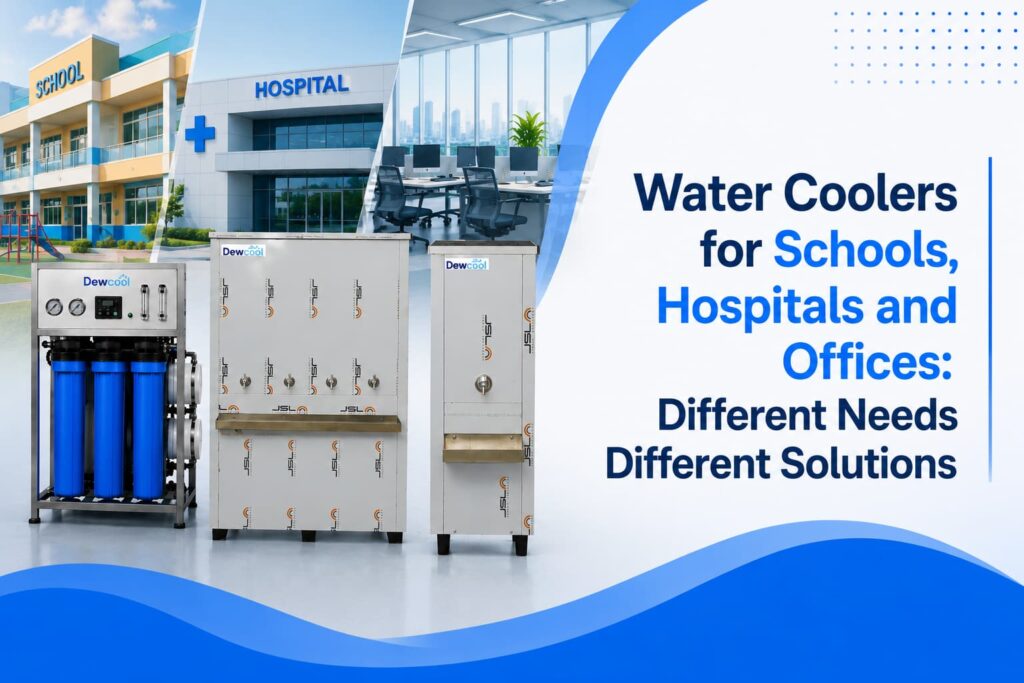
A school, hospital and office may all need access to chilled drinking water, but their requirements are far from identical. A cooler that works well for a 40-person office may not be suitable for a busy hospital, while a school needs to consider student traffic, hygiene and accessibility.
That is why choosing a cold water cooler should begin with the environment in which it will be used—not simply the price or tank size.
For organisations in Mumbai, where warm weather can make chilled drinking water an everyday requirement, selecting the right capacity, construction and cooling performance can make a significant difference to reliability and user experience.
Dewcool’s water cooler range is specifically designed for environments including schools, offices, hospitals, factories and public spaces, with multiple capacity options for different levels of demand.
Why Different Workplaces Need Different Water Coolers?
The right commercial water cooler depends on several factors:
- Number of people using the system
- Peak-hour water consumption
- Available installation space
- Required cooling capacity
- Storage requirements
- Water source and quality
- Hygiene and cleaning requirements
- Expected operating hours
- Maintenance and service requirements
For example, an office may experience its highest demand during lunch and afternoon breaks, while a hospital can have a more continuous requirement throughout the day.
The goal is therefore not to buy the biggest cooler available. It is to choose a system that can comfortably handle the actual demand of the facility.
Water Coolers for Offices: Focus on Convenience and Consistent Demand
Office water consumption tends to follow predictable patterns. Employees may use the cooler during arrival, breaks, lunch and throughout the working day.
For water coolers for office environments, consider:
1. Employee Count
A small office with a limited number of employees may not require an industrial-capacity unit. A larger corporate office, however, may need higher cooling and storage capacity, particularly if several departments share one drinking-water point.
2. Peak Usage
Average consumption doesn’t tell the whole story. If 20 people use the cooler within a short period, the system needs sufficient cooling performance and storage to cope with that demand.
3. Available Space
The cooler should be positioned somewhere that is easily accessible without obstructing movement. Adequate ventilation around the equipment should also be considered.
For workplaces that need both regular and chilled water, a plain and cold water cooler can be useful. Dewcool’s range includes systems designed to provide both plain and chilled drinking water for offices and other high-demand environments.
Schools Need Accessibility, Hygiene and Capacity
Schools present a different challenge because water consumption can be concentrated around recesses, lunch breaks and school dispersal times.
A suitable cold water cooler for schools should therefore be selected with student traffic and peak demand in mind.
Important considerations include:
- Easy access for students and staff
- Hygienic water-contact surfaces
- Durable construction
- Adequate cooling capacity
- Sufficient storage for peak periods
- Easy cleaning and maintenance
- Safe placement away from congested walkways
Access to safe drinking water is also an important part of a healthy school environment. WHO notes that children need access to safe and sustainable water, sanitation and hygiene services in schools.
Dewcool’s Cold Water Series is designed for schools and offers multiple capacity configurations, from smaller systems such as the WC2020FSS to larger heavy-duty models.
Hospitals Have More Demanding Requirements
Hospitals require particularly careful consideration because drinking-water access forms part of a broader hygiene and healthcare environment.
WHO identifies reliable access to safe water, sanitation and hygiene as essential in healthcare facilities.
When selecting a water cooler for a hospital, consider:
Continuous Demand
Hospitals operate for extended hours and may have employees, patients, attendants and visitors using water facilities. A cooler needs to be selected according to the expected demand of the specific area.
Hygienic Construction
Water-contact components and dispensing areas should be designed with hygiene and ease of cleaning in mind. Dewcool’s Cold Water Series uses a food-grade stainless-steel tank and stainless-steel construction.
Location
A hospital may require separate drinking-water points for staff, visitors and other areas rather than relying on one central unit.
Water Treatment
A water cooler primarily cools water; it should not automatically be considered a purification system. If the incoming water requires treatment, a suitable purification system should be incorporated into the overall solution.
Dewcool offers commercial and industrial water purification systems alongside its cooler range, allowing businesses and institutions to address water treatment and cooling as separate or complementary requirements.
Comparing Water Cooler Requirements by Facility
The requirements can vary significantly depending on where the cooler is installed.
For offices, the main priorities are convenience, consistent cooling and sufficient capacity for employees during regular breaks and peak usage periods. A smaller office may not need a large-capacity system, while a corporate office with hundreds of employees may require a more powerful solution.
For schools, accessibility, hygiene and durability become more important. Since many students may use the cooler within a short period during recess or lunch, the system should be capable of handling sudden increases in demand. Its placement should also allow students to access drinking water safely without creating congestion.
For hospitals, reliability and hygiene require greater attention. Water may be needed throughout the day by staff, patients and visitors. Depending on the facility, separate coolers may be appropriate for different departments or common areas. The water source and any required purification should also be assessed before selecting the system.
In simple terms:
- Offices: Focus on convenience, efficiency and employee usage.
- Schools: Prioritise accessibility, hygiene, durability and peak demand.
- Hospitals: Give greater importance to reliability, hygiene, water quality and continuous usage.
- Factories and industrial facilities: Consider higher-capacity systems designed for demanding operating environments.
The important takeaway is that the same water cooler specification should not automatically be applied to every facility. User volume, consumption patterns, operating hours and installation conditions should determine the appropriate solution.
How to Choose the Right Cold Water Cooler
Before purchasing, follow this simple process.
Step 1: Estimate Your Users
Count employees, students, staff, patients, visitors or other regular users who may access the cooler.
Step 2: Identify Peak Demand
Ask when the most people are likely to use the system. This is often more useful than looking only at daily average consumption.
Step 3: Determine Cooling and Storage Requirements
Cooling capacity and storage capacity are different. Dewcool’s Cold Water Series includes models such as the WC2020FSS with 20-litre cooling and 20-litre storage and the WC2040FSS with 20-litre cooling and 40-litre storage, alongside larger-capacity models.
Step 4: Assess the Water Source
If the incoming water needs treatment, determine whether you need a standalone purifier, an integrated solution or another appropriate treatment system.
Step 5: Consider Long-Term Support
Look beyond the purchase price. Installation, servicing, spare parts and after-sales support can affect the long-term value of a commercial water cooler.
Dewcool highlights end-to-end solutions, ready-to-install systems and after-sales support as part of its offering.
What About Smart Water Coolers?
For larger facilities or organisations managing multiple locations, a conventional cooler may not provide enough visibility into system performance.
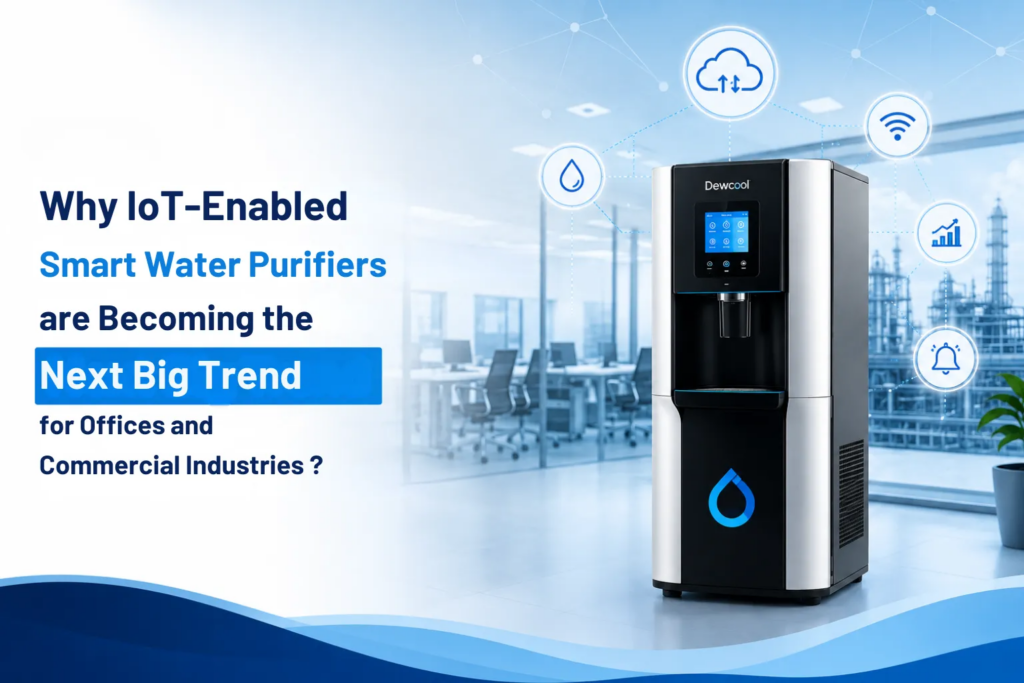
Dewcool also offers an IoT-enabled Smart Water Cooler designed for commercial, industrial and public environments.
Smart technology can be particularly relevant where facility managers need better monitoring and operational visibility. However, it should be selected because it solves a genuine management requirement—not simply because it is a newer technology.
FAQs
Which water cooler is best for an office?
The best option depends on the number of users, peak consumption, required storage, cooling capacity and available installation space. Small offices may need compact systems, while larger workplaces can require higher-capacity commercial models.
What type of cold water cooler is suitable for schools?
Schools generally need a durable, hygienic cooler with enough capacity to handle concentrated demand during breaks and other peak periods. The correct capacity depends on the student and staff population and usage pattern.
Do hospitals need high-capacity water coolers?
Not necessarily everywhere. Hospital requirements vary by department and location. High-demand areas may require higher-capacity systems, while smaller areas may need more compact units.
Is a water cooler also a purifier?
No. A water cooler is designed primarily for cooling and dispensing water. If the water source requires purification, a suitable treatment system should be considered separately or as part of an integrated solution.
How do I determine the right water cooler capacity?
Start with the number of users and estimate peak-hour demand. Then consider cooling capacity, storage capacity, operating hours and whether multiple drinking-water points are needed.
Final Takeaway
There is no single water cooler that is ideal for every institution.
Offices need convenient and reliable access. Schools need accessibility, durability and sufficient capacity during peak breaks. Hospitals require particularly careful attention to hygiene, water safety, reliability and demand.
Choosing the right cold water cooler therefore requires looking at the complete operating environment rather than selecting a model based on capacity alone.
Dewcool offers multiple water cooler configurations for offices, schools, hospitals and other high-demand environments, along with water purification solutions. Its Cold Water Series includes multiple capacity options, stainless-steel construction, rapid cooling and food-grade water tanks.
For organisations in Mumbai looking for a commercial drinking-water solution, assess your usage requirements first and then select the cooling, storage and purification configuration that fits your facility.
Looking for the right water cooler for your school, hospital or office? Explore Dewcool’s range and discuss your requirements with the team.