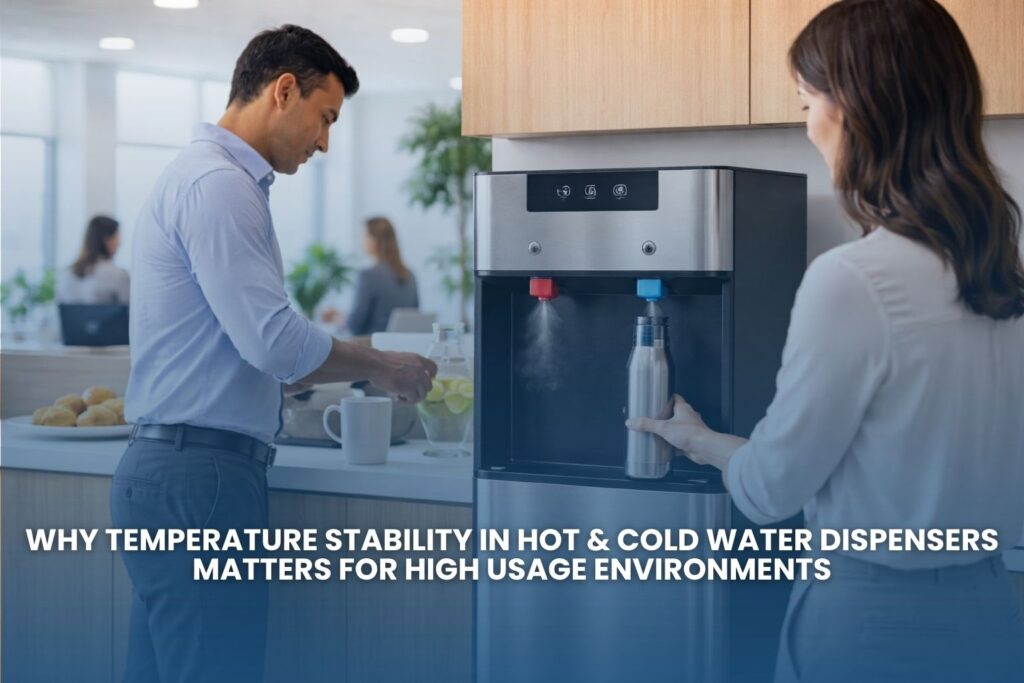
At 9:00 AM, the office pantry is buzzing. Coffee mugs line up, water bottles are being refilled, and within minutes, dozens of people rely on a single machine, the hot and cold water cooler. Now imagine this: the “hot” water is barely warm, and the “cold” water feels like room temperature. Frustration builds instantly. What seemed like a small inconvenience quickly turns into a daily operational flaw.
This is where temperature stability becomes the unsung hero of high usage environments.
The Hidden Backbone of Everyday Convenience
A hot and cold water dispenser is often taken for granted until it stops performing consistently. In spaces like corporate offices, hospitals, educational institutions, and gyms, these machines are used repeatedly throughout the day. Unlike residential use, where demand is intermittent, high usage environments place continuous pressure on the system.
Temperature stability ensures that no matter how many times the dispenser is used, the water remains reliably hot or refreshingly cold. It’s not just about comfort, it’s about maintaining a seamless experience for every user, every time.
When Stability Fails, Everything Slows Down
In high-demand settings, inconsistency creates friction. If a hot and cold water cooler cannot maintain its temperature:
- Employees wait longer for beverages.
- Customers experience dissatisfaction.
- Daily routines get disrupted.
Even a slight delay like waiting for water to reheat can ripple across a busy environment. Multiply that by dozens or hundreds of users, and the inefficiency becomes significant.
Temperature stability eliminates this bottleneck. It ensures that peak hours don’t overwhelm the system, allowing operations to flow smoothly without interruption.
Precision Matters More Than You Think
Temperature isn’t just a “hot or cold” concept; it’s a precise range. For example:
- Water that is too cool may not be refreshing enough.
- Water that isn’t hot enough may fail to properly brew tea or coffee.
- In some cases, insufficient heat may not meet hygiene expectations.
A high-quality hot and cold water dispenser is engineered to maintain exact temperature thresholds, even under continuous use. This level of precision is what differentiates a standard unit from one built for performance.
The Science Behind Stability
Behind every reliable hot and cold water cooler is a combination of smart engineering and advanced components. Systems designed for high-usage environments typically include
- High-capacity compressors and heating elements to handle constant demand
- Thermostatic controls that regulate temperature with minimal fluctuation
- Insulated tanks that preserve internal temperatures efficiently
- Fast recovery mechanisms that quickly restore desired temperatures after each use
These features work together to ensure that the system doesn’t “fall behind” when demand spikes.
Health, Hygiene, and Trust
In places like hospitals or shared workspaces, water quality is directly linked to user trust. Temperature stability plays a subtle but important role here.
Consistently cold water helps inhibit bacterial growth, while properly heated water is essential for safe beverage preparation. Fluctuating temperatures, on the other hand, can create uncertainty about water safety even if the source itself is clean.
A dependable hot and cold water dispenser reinforces confidence. Users don’t have to second-guess the quality; they simply trust the system.
Energy Efficiency: The Silent Cost Factor
An unstable system doesn’t just affect users; it impacts operational costs. When a dispenser constantly struggles to maintain temperature, it cycles more frequently between heating and cooling. This leads to:
- Higher electricity consumption
- Increased wear on internal components
- More frequent maintenance or replacements
In contrast, a temperature-stable hot and cold water cooler operates efficiently by maintaining equilibrium. It uses energy more intelligently, which is especially important in facilities where the machine runs all day.
Durability Under Pressure
High-usage environments demand more than just functionality; they demand resilience. Temperature fluctuations often signal that the internal system is under stress. Over time, this stress can lead to component failure.
A well-designed hot and cold water dispenser is built to withstand continuous operation without compromising performance. Stability reduces mechanical strain, extending the lifespan of the unit and ensuring consistent output over time.
Designing for Real-World Demand
Choosing the right hot and cold water cooler isn’t just about aesthetics or basic features. It’s about aligning the machine with real-world usage patterns.
Key considerations include the following:
- Usage volume: How many people will rely on it daily?
- Peak demand times: Are there predictable usage spikes?
- Recovery speed: How quickly can it return to optimal temperature?
- Build quality: Is it designed for commercial-grade performance?
Ignoring these factors often leads to underperforming systems that struggle to keep up.
More Than a Machine: A Daily Essential
In high-usage environments, a hot and cold water dispenser is not just an appliance; it’s part of the daily workflow. It supports hydration, productivity, and even small moments of comfort throughout the day.
Temperature stability ensures that this essential system performs reliably in the background, without drawing attention for the wrong reasons.
When demand is constant, consistency becomes critical. Temperature stability is what transforms a basic hot and cold water cooler into a dependable, high-performance solution.
It enhances user satisfaction, supports health and safety, improves energy efficiency, and ensures long-term durability. In environments where every second and every interaction counts, that level of reliability isn’t optional; it’s fundamental.
Because at the end of the day, people may not notice when a system works perfectly, but they will always notice when it doesn’t.