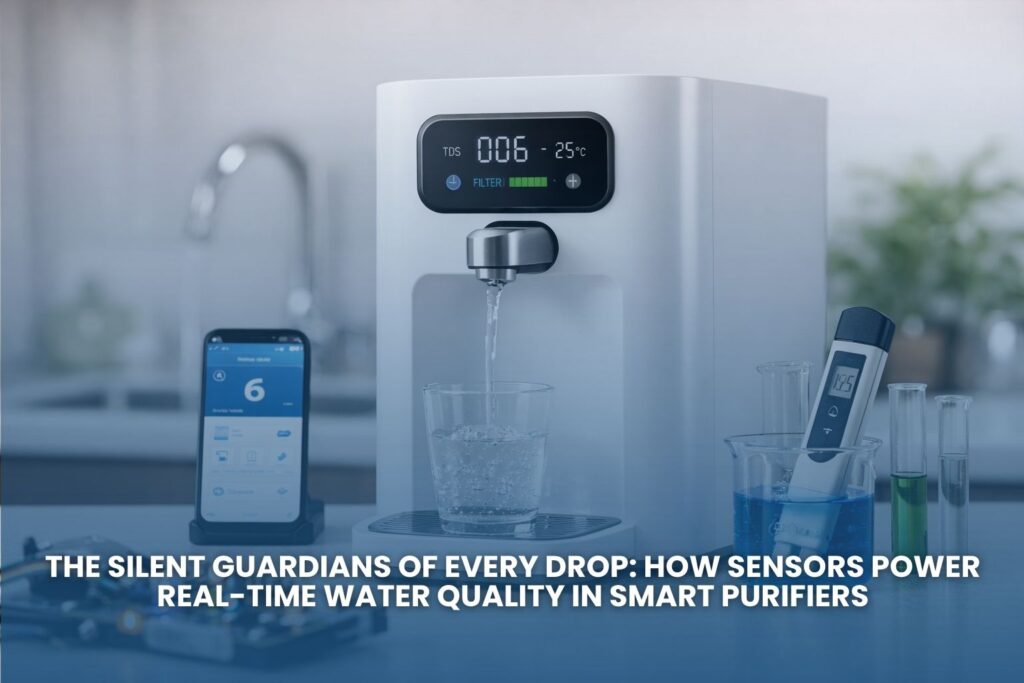
Imagine pouring yourself a glass of water that quietly tells a story of purity, safety, and precision without saying a word. Behind that clarity lies an invisible network of sensors working tirelessly, transforming ordinary filtration into an intelligent, responsive system. This is the essence of a smart purifier, where technology meets necessity in the most seamless way.
As water contamination concerns grow globally, traditional filtration methods are no longer enough. What sets a smart water purification system apart is its ability to monitor, analyze, and respond in real time. At the core of this intelligence are sensors, small yet powerful components that continuously evaluate water quality and ensure optimal purification.
Understanding the Role of Sensors in a Smart Water Purifier
A smart water purifier is not just about filtering impurities; it is about knowing what’s in your water at any given moment. Sensors act as the “eyes and ears” of the system, collecting data and triggering actions when necessary.
These sensors are embedded at different stages of the purification process, enabling continuous monitoring. Instead of passively filtering water, the system actively adapts based on real-time conditions.
Key Types of Sensors Used
- TDS (Total Dissolved Solids) Sensors
One of the most important components, TDS sensors measure the concentration of dissolved substances like salts, minerals, and metals.- High TDS levels may indicate contamination
- Low levels may suggest over-filtration, stripping essential minerals
- A smart purifier uses this data to adjust filtration intensity, maintaining the perfect balance.
- pH Sensors
Water should ideally be neutral or slightly alkaline. pH sensors monitor acidity or alkalinity levels.- Acidic water can corrode pipes and harm health
- Alkaline imbalance can affect taste and usability
- Real-time pH monitoring ensures the water remains within safe consumption limits.
- Turbidity Sensors
These sensors detect suspended particles that make water cloudy.- Increased turbidity can indicate microbial presence or sediment
- The system can immediately trigger additional filtration
- This is especially important in areas where water quality fluctuates frequently.
- Flow Sensors
Flow sensors track how much water is being purified and consumed.- Helps detect leaks or abnormal usage
- Ensures filters are not overworked
- This data also supports predictive maintenance.
- Temperature Sensors
While often overlooked, temperature can affect both water quality and filtration efficiency.- High temperatures can encourage bacterial growth
- Sensors help maintain optimal operating conditions
- Contaminant-Specific Sensors
Advanced smart water purification systems may include sensors for specific contaminants such as chlorine, heavy metals, or organic compounds.- Provides highly targeted purification
- Enhances safety in industrial or urban environments
Real-Time Monitoring: How It Works
The magic of a smart purifier lies in its ability to process sensor data instantly. Here’s how the system typically functions:
- Data Collection
Sensors continuously gather data about water quality parameters. - Data Processing
The purifier’s internal microcontroller or connected software analyzes the readings. - Decision Making
Based on predefined thresholds, the system decides whether adjustments are needed. - Action Execution
- Adjusts filtration stages (e.g., RO membrane pressure)
- Activates UV or additional purification layers
- Alerts users if water quality drops below safe levels
- User Feedback
Many smart water purifiers connect to mobile apps, displaying real-time water quality metrics and notifications.
Benefits of Sensor-Based Monitoring
1. Enhanced Safety
Continuous monitoring ensures that any contamination is detected immediately, reducing health risks.
2. Adaptive Filtration
Unlike traditional purifiers, a smart water purifier doesn’t operate at a fixed level. It dynamically adjusts based on water conditions.
3. Efficient Resource Usage
Sensors help optimize water and energy consumption by preventing unnecessary filtration cycles.
4. Predictive Maintenance
By analyzing usage and quality trends, the system can predict when filters need replacement, eliminating guesswork.
5. Transparency for Users
Users gain visibility into what they are consuming, building trust in the purification process.
Integration with IoT and Smart Ecosystems
Modern smart water purification systems often integrate with IoT platforms, enabling remote monitoring and control. This adds another layer of intelligence:
- Real-time alerts on smartphones
- Historical data tracking
- Integration with home automation systems
- Voice assistant compatibility
This connectivity transforms a simple appliance into a data-driven health companion.
Challenges and Considerations
While the technology is advanced, there are certain challenges:
- Sensor Calibration: Sensors must be periodically calibrated to maintain accuracy
- Cost: Advanced sensors can increase the overall price of the purifier
- Data Reliability: Poor sensor quality can lead to incorrect readings
- Maintenance Needs: More components mean more potential points of failure
However, ongoing innovation is rapidly addressing these limitations, making smart purifiers more accessible and reliable.
The Future of Smart Water Purification
The evolution of sensor technology is pushing the boundaries of what a smart water purifier can achieve. Future systems may include:
- AI-driven predictive contamination detection
- Self-cleaning sensors
- Real-time microbial detection at the molecular level
- Integration with municipal water systems for large-scale monitoring
As these advancements unfold, the Smart Purifier will become not just a household device but also a critical component of global water safety infrastructure.
Water is fundamental to life, yet its safety is often taken for granted. The emergence of the smart water purification system changes this narrative by introducing intelligence, transparency, and precision into everyday consumption.
Sensors, though small and often unnoticed, are the true heroes behind this transformation. They ensure that every drop you drink is continuously verified, adjusted, and perfected in real time.